
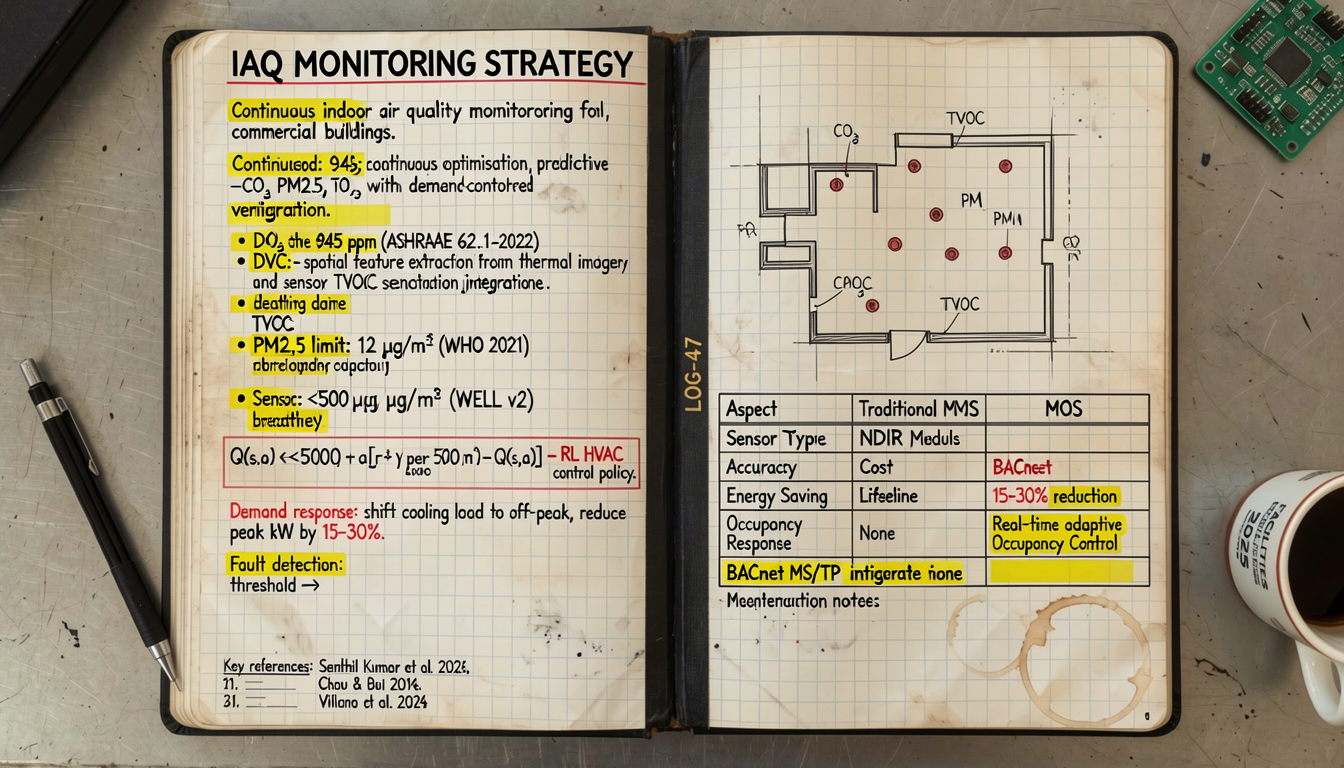
In 2026, indoor air quality monitoring has moved from "nice-to-have" to tenant expectation in commercial real estate. Across New York, Los Angeles, Chicago, and Phoenix, Class A office buildings now track CO₂, PM2.5, and TVOCs the same way they track energy consumption and occupancy [COR Advisors, 2026]. The shift is not regulatory — it is commercial. Tenants negotiating leases now ask for air quality data.
The Business Case: Why IAQ Monitoring Pays for Itself
WELL certification has grown 5x since 2022. ASHRAE's publication of Standard 241 (Control of Infectious Aerosols) in 2023 created a new compliance benchmark that facility managers cannot ignore. For building owners and operators, the question has shifted from "should we monitor?" to "which parameters and how granular?"
| Driver | Impact | Source |
|---|---|---|
| Productivity | Elevated CO₂ (945 ppm vs 550 ppm) correlates with 15% decline in cognitive function scores | Harvard T.H. Chan, 2015 |
| Energy | DCV based on real-time CO₂ sensing reduces outdoor air intake by 30-40%, sensor costs recovered in 18-24 months | ASHRAE 62.1 User's Manual |
| Compliance | ASHRAE 62.1-2022 Addendum ab now explicitly permits CO₂-based DCV with breathing-zone sensors | ASHRAE 62.1-2022 ab |
| Certification | WELL v2 grew 5x since 2022; ASHRAE 241 created new compliance benchmark | IWBI, 2026 |
Demand-Controlled Ventilation: The Fastest Path to Savings
Demand-controlled ventilation (DCV) based on real-time CO₂ and occupancy sensing is the fastest path to both compliance and energy savings. ASHRAE 62.1-2022 Addendum ab now explicitly permits CO₂-based DCV when sensors are placed in the breathing zone — closing a long-standing ambiguity that made some engineers hesitant to specify sensor-driven ventilation strategies.
The old model of fixed outdoor air fraction is dead. ASHRAE 90.1-2025 and EN 16798-1 both mandate demand-controlled ventilation tied to real-time occupancy data. CO₂-based DCV that maintains indoor air quality while reducing outdoor air treatment load by 30-40% is now the minimum standard.
CO₂ above 1,000 ppm in a conference room is not just stuffy — it is measurable cognitive drag. Harvard research showed a 15% decline in decision-making scores at 945 ppm vs 550 ppm. The fix is not more outside air blindly — it is demand-controlled ventilation with sensors in the breathing zone.
What Specifiers Should Require in Performance Briefs
Three parameters that facility managers consistently undervalue:
| Parameter | Why It Matters | Guidance |
|---|---|---|
| CO₂ | Cheapest proxy for ventilation adequacy; 400 ppm rise above outdoor ambient = 15% cognitive decline | NDIR sensor, breathing zone, BACnet output |
| PM2.5 | Often worse indoors than out in urban offices with unfiltered make-up air | Laser-based particle counter, maintenance alert at <12 µg/m³ |
| TVOC | Off-gassing from new furniture and finishes persists for 6-12 months post-fitout | MOS sensor, trend logging for IAQ commissioning reports |
Four non-negotiable requirements in every performance brief:
- POE sensors with open protocol output — BACnet or Modbus. Avoid proprietary wireless ecosystems that lock the building into one vendor's cloud dashboard.
- CO₂ + PM2.5 + TVOC as minimum parameters — not just CO₂ alone. Particulate matter from unfiltered outdoor air and VOCs from off-gassing materials contribute independently to occupant complaints.
- Breathing-zone placement — sensors mounted at 1.1-1.7 m height in occupied zones, not in return air ducts where CO₂ is diluted.
- Integration with the BMS — sensor data that lives in a separate dashboard is useless for automated ventilation control. Push data to the building automation system where sequences can act on it.
The Sensor Commoditisation Trap
The hardware is commodity. Consumer-grade 8-in-1 IAQ monitors now sell for under $200 — CO₂, PM2.5, PM10, TVOC, HCHO, temperature, humidity, all on a single PCB. But specifying consumer hardware for commercial buildings is a false economy. The value is not in the sensor — it is in the integration.
The specifier trap: buying "smart" DCV sensors that lock data behind a proprietary dashboard. Insist on BACnet or Modbus output. The sensor is a commodity — integration is where the value sits.
Cross-Border Relevance: Asia-Pacific and Middle East
For firms operating across Asia-Pacific and the Middle East, the IAQ landscape is converging rapidly:
| Rating System | Jurisdiction | IAQ Alignment |
|---|---|---|
| BEAM Plus | Hong Kong | IAQ credits now align with WELL v2 benchmarks |
| Green Mark | Singapore | DCV mandated in new office builds under BCA Green Mark 2026 |
| Al Sa'fat | Dubai | IAQ monitoring requirements following WELL v2 |
A sensor spec written once can serve projects from Kowloon to Kuala Lumpur without modification — provided you avoid region-locked cloud platforms.
Bottom Line
IAQ monitoring is not an amenity. It is an operational asset that pays for itself through energy savings, tenant retention, and compliance. The hardware is commodity; the integration strategy is where your project wins or loses. Continuous monitoring with open-protocol sensors feeding the BMS is now table stakes for Class A office buildings — and the trend is spreading to education, healthcare, and retail.
Have an IAQ monitoring question?
Lady Havi, our AI host, is ready to help. Search the HVAC controls knowledge base — CO₂ sensor placement, DCV control sequences, BACnet integration, WELL certification requirements. Ask Havi for answers backed by engineering standards.
Ask Havi
Sources
- ASHRAE Standard 62.1-2022, Addendum ab (2023) — CO₂-based demand-controlled ventilation with breathing-zone sensor placement.
- Harvard T.H. Chan School of Public Health. "Associations of Cognitive Function Scores with Carbon Dioxide, Ventilation, and Volatile Organic Compound Exposures in Office Workers" (2015).
- COR Advisors. "Indoor Air Quality Monitoring in Buildings 2026" (2026).
- ASHRAE Standard 241-2023. Control of Infectious Aerosols.
- International WELL Building Institute (IWBI). WELL v2 Certification Growth Report (2026).
Related Articles
- VAV Damper Selection for Commercial Buildings: Sizing, Types, and Specification Pitfalls
- How Asian Building Codes Are Driving a Convergence in Energy Efficiency Specifications
- Modern BMS Integration: From Traditional DDC to IoT-Enabled Building Controls
Published July 2026. This article is part of the XINCA HVAC controls engineering knowledge base. For building automation engineers, facility managers, and IAQ consultants specifying commercial ventilation systems. Search the knowledge base at help.xinca.com.
#IAQ #DemandControlledVentilation #HealthyBuildings #HVAC #BuildingAutomation #IndoorAirQuality