
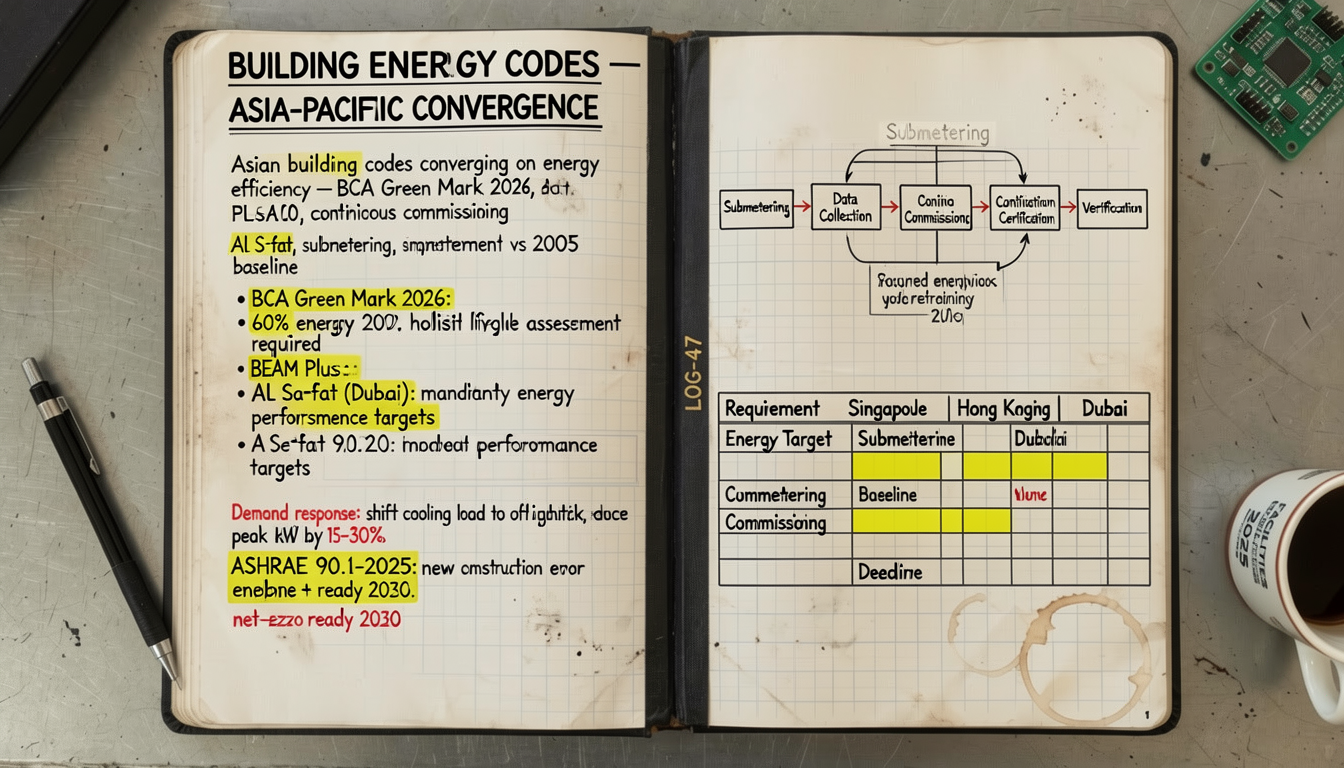
The conversation around building energy efficiency has shifted from "why should we?" to "by when?" Building codes across Asia — Singapore's BCA Green Mark 2026, Hong Kong's BEAM Plus v2.0, and Dubai's Al Sa'fat — have all updated within the 2025-2026 cycle to mandate submetering, continuous commissioning, and minimum 30% energy improvement over baseline. While each code approaches compliance differently, the specification implications are remarkably consistent.
The Three-Code Convergence
| Requirement | BCA Green Mark 2026 (SG) | BEAM Plus v2.0 (HK) | Al Sa'fat (Dubai) |
|---|---|---|---|
| Submetering | Mandatory — per floor/zone for new commercial | Mandatory — extended to major retrofits | Required for large commercial |
| Energy Improvement | 30%+ over baseline | 30%+ over baseline | 30%+ over baseline |
| Commissioning | Continuous monitoring required | Extended commissioning | 3-year monitoring period in tenders |
| DCV | CO₂-based DCV mandated | Demand-controlled ventilation required | Occupancy-based ventilation control |
| Data Granularity | 15-min intervals | Sub-metering at floor level | Interval data for energy audits (ISO 50002) |
Submetering Is Now Mandatory — Design It In from Day One
BCA Green Mark 2026 requires per-floor or per-zone energy submetering for new commercial buildings. BEAM Plus v2.0 extends this to major retrofits. For controls specifiers, this means BACnet-based energy meters must be designed into the BAS from the schematic phase — retrofitting submetering post-occupancy is 3-5x more expensive and often incompatible with proprietary BAS protocols.
Energy audits under ISO 50002 require interval data at 15-minute granularity. Proprietary BAS protocols that do not export at this granularity are increasingly non-compliant. BACnet/IP and Modbus TCP remain the safe specification choice across all three jurisdictions.
Continuous Commissioning Is Changing the Contract Model
Gulf projects increasingly include a 3-year monitoring-and-commissioning period in the controls tender. The specifier's deliverable shifts from "system commissioned at handover" to "system performing to design intent for 36 months." This fundamentally favours open-protocol BAS platforms that produce auditable trend logs at 15-minute intervals [ISO 50002].
The specifier's scope is changing: from "install and commission" to "install, commission, and monitor for 3 years." Proprietary BAS platforms that cannot export 15-minute interval data are dead on arrival in Gulf tenders.
IAQ and Energy Efficiency Are Converging — By Code
ASHRAE 90.1-2025 and EN 16798-1 both mandate demand-controlled ventilation tied to real-time occupancy data. The old fixed-outdoor-air-fraction approach satisfies neither code. CO₂-based DCV that maintains indoor air quality while reducing outdoor air treatment load by 30-40% is now the minimum standard [ASHRAE 62.1-2022].
The intersection of IAQ and energy efficiency is no longer a trade-off — it is a code requirement. Singapore's BCA Green Mark 2026 now mandates CO₂-based DCV in all new office builds. ASHRAE 90.1-2025 follows suit. Demand-controlled ventilation that responds to real-time occupancy saves 30-40% on outdoor air treatment costs while maintaining CO₂ below 800 ppm.
What This Means for Specifiers Today
| Action | Why | Target Code |
|---|---|---|
| Specify BACnet/IP or Modbus TCP for all energy meters | Proprietary protocols cannot meet 15-min granularity audit requirements | ISO 50002, all three codes |
| Design submetering at schematic phase | Post-occupancy retrofit is 3-5x costlier; proprietary BAS may block integration | BCA GM 2026, BEAM Plus v2.0 |
| Budget for 3-year post-handover monitoring | Gulf tenders now include continuous commissioning as standard scope | Al Sa'fat, ISO 50002 |
| Specify CO₂-based DCV with breathing-zone sensors | Fixed OA fraction satisfies neither ASHRAE 90.1-2025 nor EN 16798-1 | ASHRAE 90.1-2025, EN 16798-1 |
The Specification Language You Write Today
For consultants and specifiers working across markets, the message is clear: design for BACnet/IP or Modbus TCP, specify continuous monitoring capability, and budget for post-handover commissioning services. The codes are converging — and the specification language you write today determines whether your project is compliant in 2030.
The variance across these three codes is in enforcement timelines, not ambition. Net-zero ready by 2030-2035 is the common trajectory. The controls engineer who can deliver a single specification that satisfies all three jurisdictions — BACnet/IP, 15-minute interval data, CO₂-based DCV, and continuous commissioning capability — has a substantial competitive advantage.
Have a building code compliance question?
Lady Havi is ready to help. Search the HVAC controls knowledge base — BCA Green Mark, BEAM Plus, Al Sa'fat, ASHRAE 90.1, EN 16798-1, ISO 50002. Ask Havi for answers backed by engineering standards.
Ask Havi
Knowledge Base Q&A
- What does ASHRAE 90.1 require for HVAC controls?
- What is supply air temperature reset and how is it implemented?
- What are the minimum outdoor air damper leakage requirements in ASHRAE 90.1?
Sources
- Building and Construction Authority (BCA). BCA Green Mark 2026 — Energy Efficiency Requirements for New Commercial Buildings. Singapore, 2026.
- BEAM Society Limited. BEAM Plus New Buildings v2.0. Hong Kong, 2026.
- Dubai Municipality. Al Sa'fat Green Building Rating System — Update 2025-2026. Dubai, 2026.
- ISO 50002:2014. Energy Audits — Requirements with Guidance for Use.
- ASHRAE Standard 90.1-2025. Energy Standard for Buildings Except Low-Rise Residential.
- EN 16798-1:2019. Energy Performance of Buildings — Ventilation for Buildings.
- ASHRAE Standard 62.1-2022, Addendum ab. Demand-Controlled Ventilation.
Related Articles
- Modern BMS Integration: From Traditional DDC to IoT-Enabled Building Controls
- Continuous IAQ Monitoring Is Now Table Stakes for Commercial Buildings
- How AI Is Reshaping Building Energy Management
Published July 2026. This article is part of the XINCA HVAC controls engineering knowledge base. For building automation engineers, energy consultants, and specifiers working across Asia-Pacific and Middle East markets. Search the knowledge base at help.xinca.com.
#EnergyEfficiency #BuildingCodes #GreenMark #BEAMPlus #BuildingAutomation #Submetering