
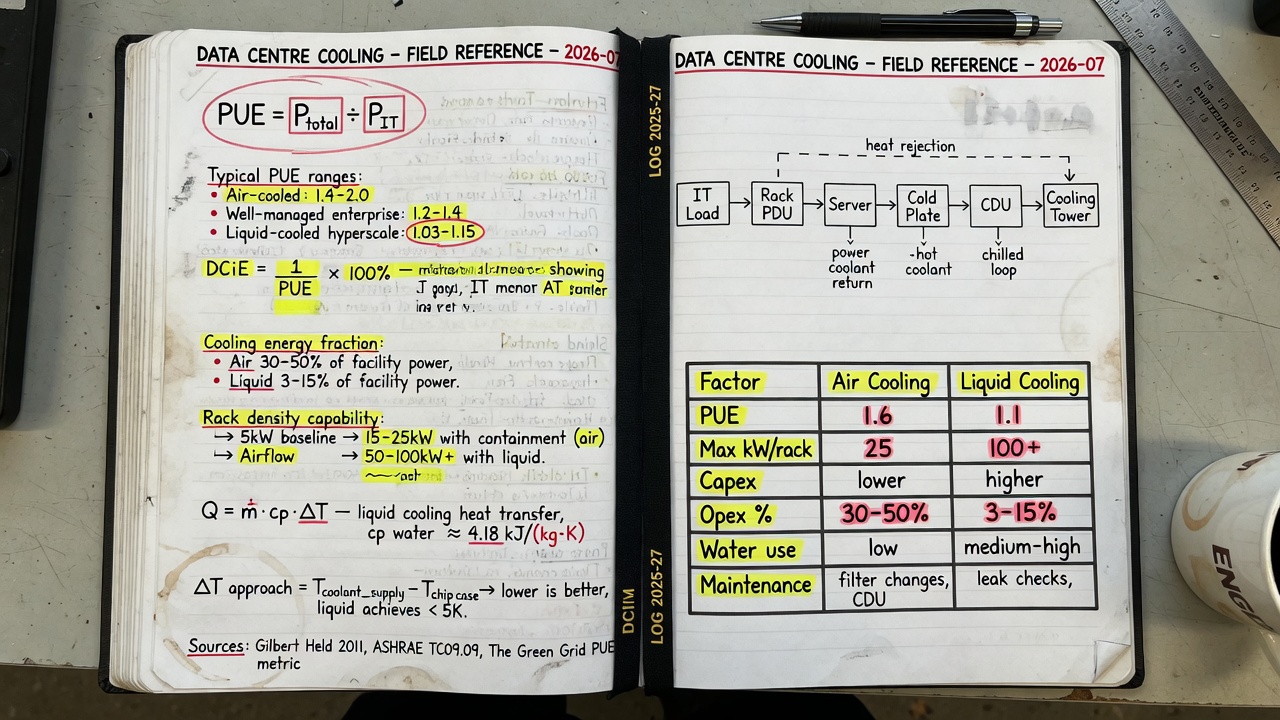
Every kilowatt that enters a data center follows a simple rule: what is not consumed by computing equipment must be paid for in cooling. As of 2026, the cost of ignoring that rule has never been higher. Data centers consumed an estimated 2-3% of global electricity in 2025, and AI training workloads are pushing individual rack power densities well past 25 kilowatts — territory where conventional air cooling reaches its practical ceiling.
The 2026 Imperative
Three forces have converged to make data center energy efficiency a first-order concern:
- AI GPU density. Where a traditional enterprise rack might draw 5 kW, a GPU-equipped rack for HPC or AI inference routinely draws 15 kW, 25 kW, or more.
- Grid constraints. Energy costs and connection moratoriums in major data center markets (Northern Virginia, Dublin, Singapore) are forcing operators to do more with less.
- Regulatory pressure. EU and North American frameworks are mandating energy performance disclosure and setting carbon targets.
The result: cooling has become a competitive differentiator. Operators who reduce cooling overhead gain lower opex, higher rack density, and compliance readiness — simultaneously.
PUE Explained
Power Usage Effectiveness (PUE) is the standard industry metric, defined by The Green Grid:
PUE = Ptotal / PIT
Where Ptotal is total facility power and PIT is power delivered to computing equipment. A PUE of 1.0 means zero overhead; 2.0 means every watt of computing costs another watt in facility overhead.
| PUE | What It Means | Typical Context |
|---|---|---|
| 1.03–1.15 | Near-perfect; almost all power reaches IT | Liquid-cooled hyperscale |
| 1.4–1.6 | Good efficiency with airflow optimisation | Well-managed enterprise |
| 1.6–2.0 | Industry average; significant cooling overhead | Legacy colocation |
| >2.0 | Inefficient; urgent optimisation needed | Older facilities, poor airflow |
The critical insight: PUE is not a static design parameter. It fluctuates with IT load, outdoor temperature, and cooling configuration. Real-time measurement via IPMI, PMBus, and rack PDU monitoring — integrated with DCIM software — allows continuous tracking and adjustment.
Rack Placement and Airflow
Before investing in liquid cooling, the most cost-effective gains come from rethinking airflow:
- Hot aisle / cold aisle. Alternating rack rows so intakes face intakes and exhausts face exhausts prevents supply/return air mixing. This alone can enable rack densities from ~5 kW to 25 kW or more.
- Containment. Physical barriers (doors, chimney returns, end caps) eliminate bypass and recirculation. ASHRAE TC09.09 research confirms containment is the most reliable method for raising allowable supply air temperatures.
- Under-floor pressure management. DCIM-integrated pressure transducers and variable-speed fans enable active balancing across raised-floor facilities.
These airflow measures are not a substitute for liquid cooling — they are prerequisites. A poorly managed air path defeats any cooling technology downstream.
Liquid Cooling vs. Air Cooling
Liquid cooling encompasses direct-to-chip cold plates, rear-door heat exchangers, and immersion — all sharing a common advantage: the heat transfer coefficient of liquid is orders of magnitude higher than air. Water-cooled solutions can reduce PUE from above 1.6 to below 1.1.
| Factor | Air Cooling | Liquid Cooling |
|---|---|---|
| Max rack density | ~15-25 kW (with containment) | 50-100+ kW per rack |
| Typical PUE | 1.4-2.0 | 1.03-1.15 |
| Free cooling potential | Climate-dependent | Year-round with warm-water loops |
| Retrofit complexity | Low to moderate | Moderate to high (plumbing, CDU) |
| Capex | Low (panels, blanking) | High (cold plates, CDUs, piping) |
| Opex (cooling energy) | ~30-50% of facility total | ~3-15% of facility total |
| Water consumption | High (evaporative) | Lower (closed-loop option) |
What the Numbers Say
ASHRAE Technical Committee 09.09 — responsible for mission-critical facilities — has published widely cited guidance with key findings:
- Rack density trajectory: Densities increase from 5 kW baseline to 10, 15, and 25+ kW. Beyond ~15-20 kW, air alone becomes uneconomical within standard 42U racks.
- Real-time measurement necessity: At 25 kW/rack, the thermal runaway window collapses to seconds — PMBus, rack PDU metering, and DCIM integration are no longer elective.
- Liquid PUE advantage: Facilities using liquid cooling consistently achieve PUE below 1.1, with optimised installations approaching 1.03.
- Firmware strategies: DCIM-driven fan-speed adjustment, pump modulation, and predictive cooling load management yield an additional 5-15% reduction beyond hardware gains.
Key Takeaways
- PUE is the starting metric, not the destination. Measure it continuously at the rack level using IPMI/PMBus and DCIM.
- Airflow optimisation is cheap and mandatory. Hot/cold aisle and containment should precede any capital-intensive cooling upgrade.
- The air ceiling is real. Beyond ~20-25 kW/rack, liquid cooling becomes the practical default.
- Liquid cooling drives the lowest PUE. Industry data shows liquid-cooled facilities at PUE below 1.1 vs. 1.6+ for conventional designs.
- Monitoring unlocks firmware-level savings. Rack PDU data feeds DCIM-driven optimisation strategies that reduce energy without hardware changes.
Knowledge Base Q&A
- How do I measure pump efficiency using BAS data?
- What is the optimal placement for a chilled water differential pressure sensor?
- How do I design a low-ΔT syndrome solution for chilled water plants?
Sources
- Held, Gilbert. Making Your Data Center Energy Efficient. CRC Press, 2011. — Practical framework for rack-level power management, PUE measurement, and airflow optimisation.
- ASHRAE Technical Committee 09.09. White papers and technical guidance on real-time energy consumption measurements, liquid cooling architectures, and PUE optimisation.
- The Green Grid. PUE: A Comprehensive Examination of the Metric. — Original industry consortium definition of Power Usage Effectiveness.
Have a data center cooling question?
Search the HVAC controls knowledge base — PUE measurement, rack airflow optimisation, liquid cooling design, glycol loop engineering. Ask Havi, the AI chatbot, for answers backed by engineering knowledge.
Ask HaviRelated Articles
- The Coolant Trade-Off That Transforms Data Centre Economics
- How AI Is Reshaping Building Energy Management
- How Asian Building Codes Are Driving a Convergence in Energy Efficiency Specifications
Published July 2026. This article is part of the XINCA HVAC controls engineering knowledge base. For facility managers, HVAC engineers, and data center operators evaluating cooling strategy for high-density deployments. Search the knowledge base at help.xinca.com.
#DataCenter #HVAC #Cooling #PUE #LiquidCooling #FacilityManagement #EnergyEfficiency #ASHRAE