
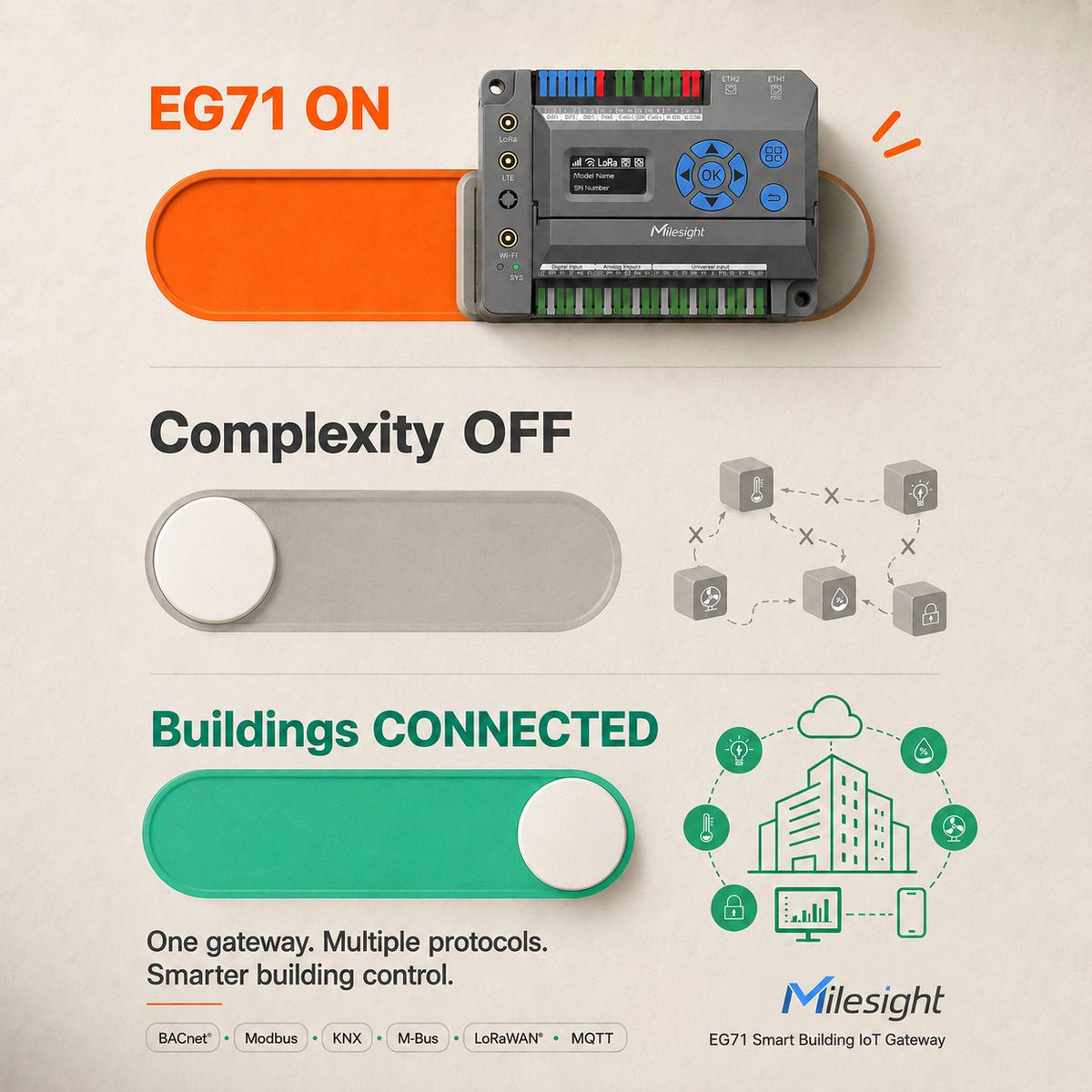
The building automation industry is crossing a threshold. For three decades, DDC controllers talking BACnet MS/TP over twisted-pair RS-485 have been the backbone of commercial building control. Now, IoT-enabled sensors, IP-based controllers, and cloud analytics platforms are layering on top of that infrastructure — and the integration challenge is not technological, it is architectural. The question is no longer "BACnet or Modbus?" It is "how do we connect the thirty-year-old chiller plant controller, the new IoT sensor network, and the cloud analytics platform into a single coherent system?"
BACnet vs Modbus: The Protocol Decision That Shapes Your Architecture
BACnet and Modbus are the two protocols that carry the vast majority of commercial building control traffic. They are fundamentally different in design philosophy, and the choice between them shapes the entire integration architecture:
| Characteristic | BACnet | Modbus RTU/TCP |
|---|---|---|
| Design philosophy | Object-oriented — devices expose standard objects (AI, AO, BI, BO, AV, BV, schedule, calendar, trend log) | Register-oriented — devices expose 16-bit registers (holding, input, coil, discrete) |
| Discovery | Who-Is / I-Am — devices self-identify; BMS can auto-discover the entire network | No native discovery — engineer must know device addresses and register maps in advance |
| Data modelling | Rich — engineering units, alarm states, trend logs, schedules built into the protocol | Lean — raw register values; meaning assigned by external documentation |
| Transport | MS/TP (RS-485), BACnet/IP (UDP 47808), Ethernet, ARCNET | RTU (RS-485), TCP/IP (port 502) |
| Best application | BMS backbone, HVAC controllers, multi-vendor integration | Power meters, VSDs, chiller gateways — simple, high-speed point data |
| Vendor lock-in risk | Low — BTL certification ensures interoperability | Medium — register maps are vendor-specific; replacement requires re-mapping |
The modern BMS architecture uses both: BACnet as the integration backbone for HVAC controllers and building-level functions, Modbus for simple, high-speed data from power meters, VSDs, and packaged plant controllers. The integration layer — typically a BACnet/IP to Modbus TCP gateway or a JACE-class supervisor — handles the translation.
The single biggest mistake in BMS integration is treating the protocol as the architecture. BACnet and Modbus are transport — the architecture is the data model, the naming convention, the alarm classification, and the trend log strategy that sits above them. A well-designed Modbus system with a consistent point naming convention and structured alarms will outperform a poorly designed BACnet system every time.
Sensor Network Architecture: From Star to Mesh
The physical layer of building controls is transforming faster than the protocols:
| Architecture | Topology | Typical Protocol | Installation Cost per Point | Best For |
|---|---|---|---|---|
| Hardwired star | Each sensor home-run to DDC panel | 0-10 V, 4-20 mA, dry contact | High — cable and conduit per point | Retrofit where conduit exists; critical safety points |
| RS-485 trunk | Daisy-chain on single twisted pair | BACnet MS/TP, Modbus RTU | Medium — one cable serves 32-128 devices | Standard for VAV boxes, FCUs, unitary controllers |
| Wireless mesh | Self-healing network; each node relays | Zigbee, Thread, LoRaWAN, BLE Mesh | Low — no cable; sensor cost premium 20-40% | Zone sensors, IAQ monitoring, occupancy sensing |
| IP-based (IoT) | Each sensor has an IP address on the building LAN | BACnet/IP, MQTT, HTTP/REST | Medium — PoE cable or Wi-Fi; no proprietary gateway | New construction; analytics-driven retrofits; cloud-connected BMS |
The strongest trend in 2026 is the hybrid architecture: RS-485 trunk for the primary HVAC controllers (VAV boxes, AHUs, chiller plant), with wireless mesh sensors for zone-level IAQ, occupancy, and energy metering — all feeding into a BACnet/IP backbone that exposes everything to the BMS supervisor and cloud analytics.
IoT Migration: A Phased Strategy That Preserves Operations
Upgrading a legacy DDC system to an IoT-enabled architecture cannot be a "rip and replace" exercise — the building is occupied, the chiller plant is running, and any outage during business hours is unacceptable. The proven migration path is four phases:
- Phase 1 — Overlay, don't replace. Install a BACnet/IP-to-MSTP router that exposes the legacy MS/TP trunk to the IP network. The existing DDC controllers continue operating unchanged; the router simply makes their data available to a modern supervisor. Cost: typically under AUD 3,000 for a single-trunk router. Risk: near-zero — the legacy controllers do not know the router exists.
- Phase 2 — Add analytics and fault detection. With the legacy data now available on the IP network, deploy a fault detection and diagnostics (FDD) platform that analyses trends without writing to any controller. This phase delivers immediate value — identifying stuck dampers, hunting valves, and simultaneous heating and cooling — without touching the control logic.
- Phase 3 — Add IoT sensors at the zone level. Deploy wireless IAQ, occupancy, and energy sensors in zones that the legacy system never monitored. These feed directly into the analytics platform and provide data for Phase 4 control sequence upgrades. No integration with the legacy controllers is required at this stage.
- Phase 4 — Replace controllers as they fail (natural lifecycle). When a legacy DDC controller reaches end of life, replace it with a BACnet/IP native controller that runs ASHRAE Guideline 36 sequences. The new controller communicates directly on the IP backbone alongside the remaining legacy controllers behind the router. Over 5-7 years, the system transitions fully to IP-native without a single building shutdown.
Protocol Integration: Making Different Systems Talk
The reality of commercial buildings is that no single protocol covers every device. A typical large commercial building in 2026 might include:
| System | Typical Protocol | Integration Method |
|---|---|---|
| Chiller plant controller | BACnet/IP or Modbus TCP | Direct IP connection to BMS supervisor |
| VSDs (pumps, fans) | Modbus RTU (RS-485) or BACnet MS/TP | RS-485 trunk to field controller or protocol gateway |
| Power meters | Modbus RTU | Modbus-to-BACnet gateway or direct Modbus TCP via serial server |
| Lighting control | DALI, KNX, or proprietary | BACnet gateway — typically vendor-specific |
| Fire alarm panel | BACnet or hardwired dry contacts | BACnet gateway (supervised, one-direction from fire panel to BMS) |
| IoT sensors (IAQ, occupancy) | LoRaWAN, MQTT, or BACnet/IP | IoT gateway aggregating to BACnet/IP or direct MQTT-to-BACnet bridge |
The integration layer is the BMS supervisor — typically a Niagara Framework JACE or equivalent — which normalises all protocols into a unified data model. The supervisor handles protocol translation, alarm routing, trend logging, and scheduling across the entire building. The key specification requirement: demand that every subsystem vendor provides a BACnet interface (BTL-certified) or, at minimum, a documented Modbus register map. Proprietary protocols that require a vendor-specific software tool to extract data add integration cost and risk.
Cross-Border Relevance: Asia-Pacific and Middle East
BMS integration standards are converging rapidly across the key commercial building markets:
| Jurisdiction | Standard | BMS Integration Requirement |
|---|---|---|
| Singapore | BCA Green Mark 2026, SS 553 | BACnet/IP required for chiller plant and AHU systems; BTL certification mandatory for new installations |
| Hong Kong | BEAM Plus v2.0, EMSD BMS Code of Practice | Open protocol (BACnet or Modbus) mandated; proprietary BMS penalised under BEAM Plus scoring |
| Dubai | Dubai Green Building Regulations, ASHRAE 90.1-2019 | BMS with energy monitoring and fault detection mandated for buildings >10,000 m²; BACnet preferred |
The convergence point is clear: BACnet/IP as the backbone, Modbus for simple devices, and open protocols mandated by green building rating systems across all three jurisdictions. A BMS specification written to ASHRAE Standard 135 (BACnet) with BTL-certified devices is accepted without modification in Singapore, Hong Kong, and Dubai.
Bottom Line
The building controls industry is not facing a protocol war — it is facing an integration challenge. BACnet and Modbus coexist because they serve different purposes: BACnet for the BMS backbone with its rich object model and auto-discovery, Modbus for simple, high-speed data from power meters and VSDs. The migration to IoT is not about replacing these protocols — it is about layering IP connectivity, wireless sensors, and cloud analytics on top of them through a phased strategy that preserves building operations. The four-phase overlay approach — router first, analytics second, IoT sensors third, natural lifecycle replacement fourth — delivers value at every step without a single building shutdown. The protocol is the transport. The architecture — the data model, naming convention, and integration strategy — is what separates a building that can be optimised from one that can only be operated.
Have a BMS integration question?
Search the HVAC controls knowledge base — BACnet vs Modbus selection, IoT sensor network architecture, legacy DDC migration strategies, protocol gateway configuration. Ask Havi, the AI chatbot, for answers backed by engineering standards.
Ask Havi
Knowledge Base Q&A
- BACnet vs Modbus — which protocol should I choose for building automation?
- What are the common BACnet object types for HVAC control?
- What are the key differences between BACnet MS/TP and BACnet/IP?
Sources
- ASHRAE Standard 135-2020: "BACnet — A Data Communication Protocol for Building Automation and Control Networks."
- ASHRAE Guideline 36-2021: "High-Performance Sequences of Operation for HVAC Systems."
- Modbus Organisation. "Modbus Application Protocol Specification v1.1b3" (2012).
- BCA Green Mark 2026 — Building and Construction Authority, Singapore.
- BEAM Plus v2.0 New Buildings — Hong Kong Green Building Council.
- EMSD HKSAR. "Code of Practice for Building Management System" (2024).
- Dubai Municipality Green Building Regulations and Specifications (2020), referencing ASHRAE 90.1-2019.
- BACnet International. "BTL Certification Program — Testing and Listing Requirements" (2025).
Related Articles
- How AI Is Reshaping Building Energy Management
- How Asian Building Codes Are Driving a Convergence in Energy Efficiency Specifications
- VAV Damper Selection for Commercial Buildings: Sizing, Types, and Specification Pitfalls
Published July 2026. This article is part of the XINCA HVAC controls engineering knowledge base. For BMS integrators, controls engineers, and facility managers planning building automation upgrades. Search the knowledge base at help.xinca.com.
#BACnet #Modbus #BMS #IoT #BuildingAutomation #SmartBuildings