
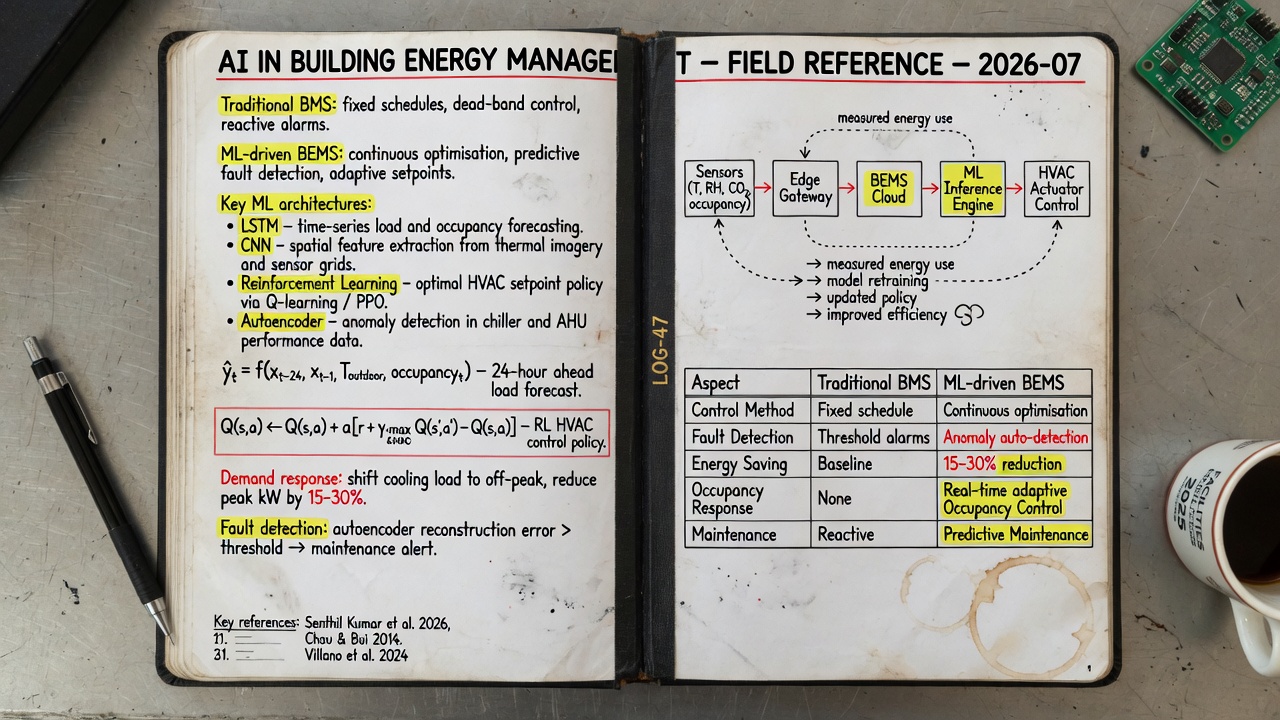
Buildings account for roughly 30% of global final energy consumption, and HVAC systems alone represent nearly half of that figure in commercial structures. For decades, the industry has relied on Building Management Systems (BMS) with Direct Digital Control (DDC) — rule-based, reactive, and limited by the programmer's foresight. That model is changing. Machine learning and deep learning methods are now being deployed to analyse operational data, forecast loads, detect faults before they cascade, and optimise energy use in real time. This is not magic. It is applied computational engineering.
The Shift from Rule-Based BMS to Data-Driven Optimisation
Traditional BMS/DDC architectures operate on fixed thresholds and schedules. A chiller starts when outdoor air hits a setpoint. An air handler ramps down at 6:00 PM on a fixed occupancy schedule. These rules are static — they do not adapt to shifting occupancy patterns, equipment degradation, or volatile electricity prices.
Machine learning models change this paradigm by learning from historical operational data rather than following hard-coded logic. A review by Villano, Mauro, and Pedace (2024) surveyed the landscape of machine and deep learning techniques applied to building energy simulation, optimisation, and management, documenting the rapid expansion of data-driven methods across all three domains.
The practical deployment pattern is a supervisory layer: ML models run alongside the existing DDC, recommending or writing setpoint adjustments that the BMS executes. This preserves safety and reliability while layering computational optimisation on top.
Predictive Maintenance and Anomaly Detection
Unscheduled equipment failures carry two costs: the repair itself and the energy penalty of degraded operation leading up to it. A chiller running with a fouled condenser may continue to meet temperature setpoints — but it consumes far more energy doing so.
Deep learning and machine learning approaches can identify anomalies by comparing real-time sensor data against learned patterns of normal behaviour. These models ingest multivariate time-series data — compressor current, refrigerant pressures, supply and return temperatures — and flag deviations that rule-based alarms would miss because individual readings remain within conventional thresholds.
The same approach applies to lighting systems, where abrupt changes in energy consumption patterns may indicate failed fixtures or ineffective schedules. Chou and Bui (2014) demonstrated the feasibility years ago using computational techniques to model heating and cooling loads for energy-efficient building design. The technology has since matured from research prototypes to commercially deployed BEMS solutions.
Demand Response Optimisation
Utilities increasingly offer demand response programs that compensate building operators for reducing load during peak periods. The challenge has always been execution: how much load can be shed, for how long, and at what cost to comfort?
Machine learning optimises demand response strategies by predicting both the timing of peak events and the building's thermal response to load-shedding. Models anticipate peak demand periods by analysing historical consumption data combined with weather forecasts, enabling proactive adjustments to HVAC settings or lighting schedules during expensive peak hours.
This turns demand response from a blunt instrument — pre-cooling on a fixed schedule — into a precision tool. The model weighs thermal mass, occupancy, weather, and price signals to produce an optimal curtailment strategy.
Occupancy-Based HVAC Control
The conventional approach assumes full occupancy during business hours and near-zero overnight. Reality is messier. Conference rooms sit empty for hours. Floors clear out early on Fridays. Open-plan areas have hot spots where density fluctuates.
Deep learning models can dynamically modify HVAC setpoints and ventilation rates based on real-time occupancy patterns and environmental variables. Inputs include CO₂ sensor readings, Wi-Fi device counts, passive infrared data, and calendar integrations. The model learns the relationship between occupancy levels, thermal load, and the optimal HVAC response — continuously refining its control strategy.
The practical benefit is substantial: rather than conditioning an entire floor to design occupancy, the system delivers ventilation and cooling where and when it is needed. This is particularly valuable in mixed-use buildings, university campuses, and healthcare facilities.
BEMS With LSTM, CNN, and Reinforcement Learning
Modern Building Energy Management Systems integrate several classes of machine learning models, each suited to different tasks:
| Model Type | Primary Application | Why It Fits |
|---|---|---|
| LSTM | Load forecasting, energy prediction | Captures long-range temporal dependencies |
| CNN | Fault detection, spatial patterns | Identifies spatial features in sensor networks |
| Reinforcement Learning | Optimal control, real-time setpoints | Learns control policies through trial and error |
| Gradient Boosting | Anomaly detection, baselines | Strong interpretability for tabular sensor data |
These techniques enable enhanced load forecasting, fault detection, optimal power flow, and demand response methods that go well beyond what conventional PID loops and schedule-based control can achieve. The models do not replace domain expertise — they amplify it by processing more data, faster, and identifying patterns invisible in trend logs.
Key Takeaways
| Takeaway | Detail |
|---|---|
| Supervisory ML layer | Practical deployments layer ML on existing DDC — preserving safety while adding optimisation |
| Anomaly detection | ML flags subtle deviations from normal operation that rule-based alarms miss |
| Precision demand response | Predictive models balance thermal mass, weather, occupancy, and price signals |
| Occupancy-driven HVAC | CO₂, Wi-Fi, and PIR data feed models delivering ventilation only where needed |
| Purpose-built model stack | LSTM for forecasting, CNN for faults, RL for control — each to its strength |
Knowledge Base Q&A
- What is ASHRAE Guideline 36 and how does it improve HVAC control sequences?
- Where should duct static pressure sensors be placed in a VAV system?
- What is the role of pressure sensors in duct static pressure reset strategies?
Sources
- Senthil Kumar, S., et al. Artificial Intelligence for Energy Management. 2026. — Chapters on BEMS, anomaly detection, demand response, occupancy-based HVAC control, and grid optimisation with LSTM/CNN/RL.
- Villano, F., Mauro, G.M., and Pedace, A. "A Review on Machine/Deep Learning Techniques Applied to Building Energy Simulation, Optimization and Management." Thermo, vol. 4, no. 1, 2024, pp. 100-139.
- Chou, J.-S. and Bui, D.-K. "Modeling heating and cooling loads by artificial intelligence for energy-efficient building design." Energy and Buildings, vol. 82, 2014, pp. 437-446.
Have a building automation question?
Search the HVAC controls knowledge base — BEMS architecture, predictive maintenance, demand response optimisation, DDC integration. Ask Havi, the AI chatbot, for answers backed by engineering knowledge.
Ask HaviRelated Articles
- Modern BMS Integration: From Traditional DDC to IoT-Enabled Building Controls
- How Asian Building Codes Are Driving a Convergence in Energy Efficiency Specifications
- HVAC Industry Statistics 2026
Published July 2026. This article is part of the XINCA HVAC controls engineering knowledge base. For building automation engineers, facility managers, and energy consultants evaluating data-driven BEMS strategies. Search the knowledge base at help.xinca.com.
#BuildingEnergy #BEMS #MachineLearning #HVAC #PredictiveMaintenance #SmartBuildings #EnergyEfficiency #DeepLearning